Introduction to Seal Engraving Knife Grips
The methods of holding the engraving knife in seal carving primarily vary depending on the tools, materials, and the size of the object being carved. Delving deeper, the evolution of engraving techniques encompasses various knife grips, with the main ones being the Three-Finger Grip and auxiliary methods. Here, we focus on two fundamental grips and the principle of adaptability.
1. The Five-Finger Grip (Wu Zhi Zhi Dao Fa)
This is the common method for daily carving. The thumb, index, and middle fingers grip the knife shaft from the sides, while the ring and little fingers provide support from behind, creating a firm grip with a hollow palm. The Five-Finger Grip can be further divided into postures resembling holding a fountain pen or a pencil. It is mostly used for carving small to medium-sized seal stones under 3-4 centimeters.
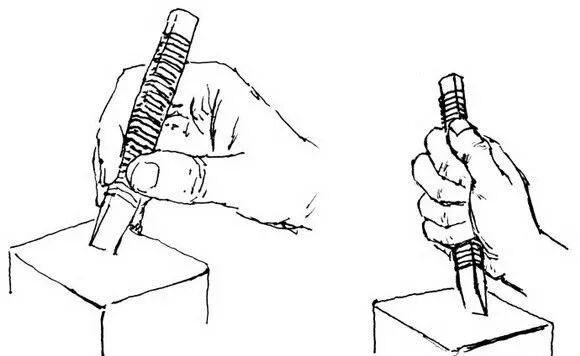
2. The Fist Grip (Wo Dao Fa)
The Fist Grip is used for larger seal stones, thicker knife bodies, or when greater force is required. All five fingers clench the knife tightly, like making a fist, with the knife shaft resting in the palm. The cutting motion often involves pulling the knife from the outside in, with the knife handle tilted outward.
3. No Fixed Rule (Wu Ding Fa)
Generally speaking, the Five-Finger Grip allows for more flexible movement and is better at expressing delicate and subtle brushstroke-like details, but it can be more challenging when applying strong vertical force onto the stone. The Fist Grip makes it easier to exert force but is less adept at handling fine details. Therefore, the choice of grip is mainly determined by factors such as the size of the carving area, the hardness of the stone, and the required intensity of force.
As a rule of thumb, use the Fist Grip for large seals and the Five-Finger Grip for small ones. From a practical standpoint, however, it can be said that there is no single fixed rule for holding the knife. It can vary from person to person, depending on the material and the knife itself. The key is to use the method comprehensively to achieve the best carving results.