Schools of Seal Engraving
By the mid-Ming Dynasty, seals had evolved into a distinctive art form of engraving. They transitioned from being practical items or accessories to calligraphy and painting into an independent art form.
During the Ming and Qing dynasties, the art of seal engraving flourished with numerous masters and diverse schools. These schools were typically named after the engraver’s native place, surname, master-disciple lineage, or region of activity. Over the nearly 500 years from the mid-Ming to the late Qing Dynasty, various stylistic schools emerged, propelling ancient Chinese seal engraving art into another period of prosperity.
Wu Men School(吴门派)
Wen Peng of the Ming Dynasty, the eldest son of the painter and calligrapher Wen Zhengming, inherited his family’s artistic traditions in poetry, calligraphy, and painting, but gained particular fame for his seal engraving. Later engravers revered him as the patriarch of seal engraving.
Wen Peng made efforts to revive the tradition of Han Dynasty seals. His seals with rounded scripts, incorporating structures from lesser seal script (Xiaozhuan), were most distinctive for their elegance and grace. His knife technique was brisk and free, and his compositional arrangements were highly ingenious. His advocacy for using the “Six Writing Principles” (Liu Shu) as a guideline remains a rule followed by engravers to this day. Due to Wen Peng’s promotion, the art of seal engraving became widely popular, opening up new creative avenues. His lineage became known as the Wu Men School.
Hui School(徽派)
He Zhen, a contemporary of equal fame to Wen Peng, initially studied under Wen Peng but later turned to Qin and Han dynasty seals for inspiration. He created various artistic forms in seal engraving and was acclaimed as a “great synthesizer” who “followed antiquity without being confined by it,” exerting a significant influence on later generations. His lineage became known as the Hui School.
Besides Wen Peng and He Zhen, other Ming Dynasty figures like Su Xuan, Gan Yang, Zhu Jian, and Wang Guan also established their own distinctive styles and founded new schools.
Wan School(皖派)
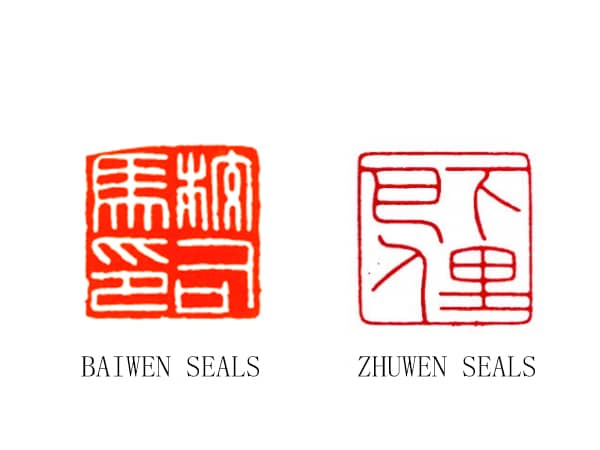
The Qing Dynasty saw an unprecedented number of seal engraving schools. In the early Qing, Cheng Sui was the most outstanding. His engraving “vigorously transformed the old practices of Wen (Peng) and He (Zhen),” demonstrating great creativity. His white-character (Baiwen) seals studied Han dynasty seals, achieving a heavy, condensed quality, while his red-character (Zhuwen) seals favored the use of great seal script (Dazhuan), creating strikingly irregular compositions. He laid the foundation for the Wan School.
Zhe School(浙派)
By the mid-Qing Dynasty, seal engraving art entered a flourishing period. The most influential and accomplished masters of this time were Ding Jing and Deng Shiru.
Ding Jing’s engraving directly drew from Ming masters, primarily Zhu Jian, while also taking Han seals as his core model. He was the founder of the Zhe School. This school was further inherited and developed by eight successors—Jiang Ren, Huang Yi, Xi Gang, Chen Yuzhong, Chen Hongshou, Zhao Zhichen, and Qian Song—becoming the most influential seal engraving school of the Qing Dynasty. These eight engravers are collectively known as the “Eight Masters of Xiling.”
Deng School(邓派)
Following Ding Jing, Deng Shiru was a pioneering figure in the history of seal engraving development. He excelled in all four major script styles: regular, cursive, clerical, and seal script.
In his early seal engraving, he studied the Hui School and was influenced by Cheng Sui. He initially incorporated lesser seal script into seals and later integrated the brushwork spirit of Stone Drum inscriptions and Han stele seal script headers, pioneering new paths by seeking inspiration beyond the realm of seals themselves. As Deng Shiru was from Anhui, his style is also referred to as the Wan School or specifically the Deng School.
Wu School(吴派)
Wu Changshuo was a giant in the late Qing art world, achieving profound mastery in poetry, calligraphy, painting, and seal engraving. He was skilled in using a blunt knife with forceful entry, employing both pushing and cutting techniques. His engraving combined elegant charm within a vigorous, archaic simplicity. He was later revered as the founder of the Wu School, exerting tremendous influence on seal engraving circles both in China and Japan.
Yishan School(黟山派)
Huang Shiling of the late Qing Dynasty showed great ingenuity in his seal compositions, creating intriguing and strikingly irregular arrangements. His knife technique was robust and powerfully unique, often leaving carvings unretouched. His engraving style was straightforward, simple, and unadorned, concealing clumsiness within cleverness, making him a rising force in the late Qing seal world. As he resided in Guangzhou for the longest time, his influence on engravers in the Lingnan region was greatest. Consequently, some named Huang Shiling’s style the Yishan School.
Qi School(齐派)
Modern seal engravers have continued to forge the developmental path of seal engraving schools. Drawing on the nation’s excellent artistic traditions, they broke through the norms of Qin and Han seals as well as Ming and Qing dynasty schools, demonstrating courage for innovation and constant exploration, ushering in a new chapter in modern seal engraving art. Among them, Qi Baishi has been the most influential. His seal engraving, characterized by a concise single-knife technique and the charm of Han Dynasty artistry, created the uniquely bold, dynamic, and powerfully vigorous style of the Qi School.